

How To Draw A Dark Room
Tutorial: how to draw an isometric dungeon map
Update! This and many more tutorials on fantasy and D&D map making is availible too on my website, together with loads of free-to-download maps, check it out — click here!
Hi anybody, as a follow-up on my last tutorial, on how to depict bones, meridian-downwardly dungeon maps, I idea I'd write a guide on how to draw isometric maps.
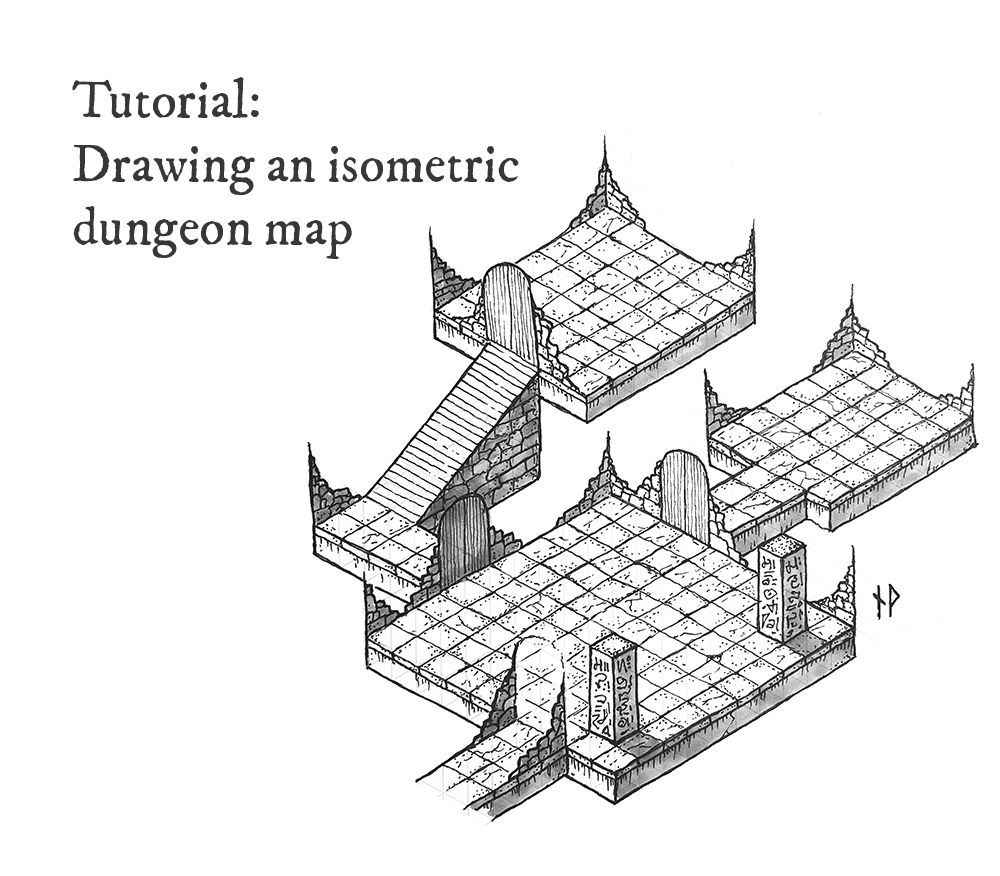
I really like isometric maps; not only do they wait good, but are also a great way of describing the difference in height between objects and flooring levels, making such maps really useful for the dungeon chief. Also, it doesn't injure that some of my favourite computer games are all isometric RPG'south (similar Diablo, Baldur's Gate, Pillars of Eternity and Tyranny).
Anyway, let'south go started!
The gear
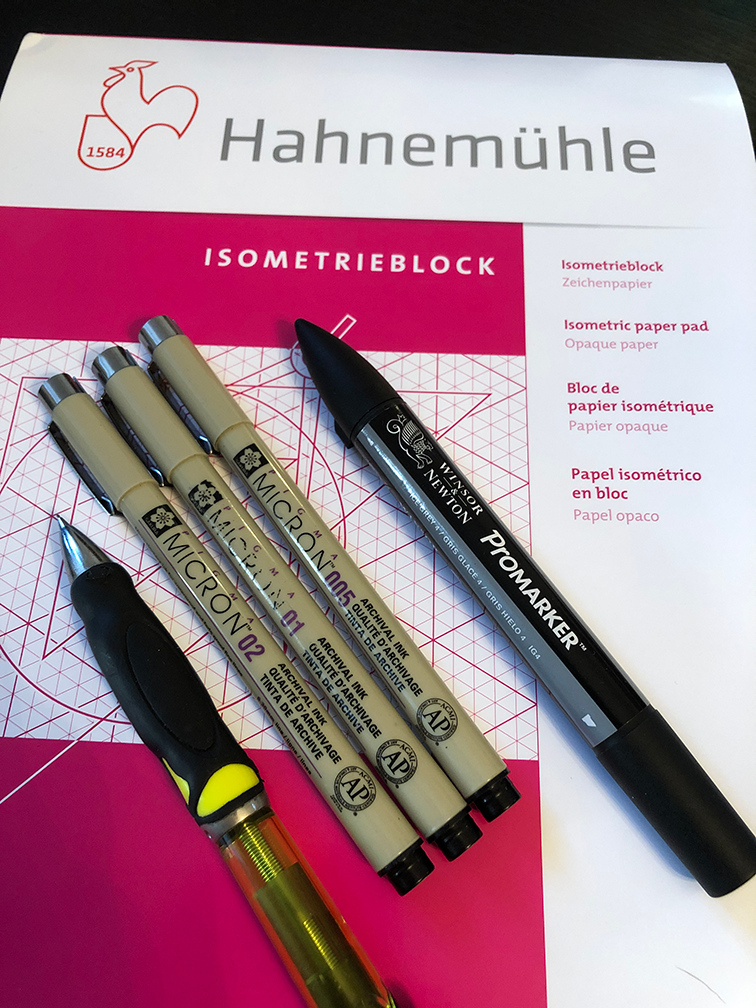
For this tutorial, I volition be using a set of Micron markers (0.05, 0.1 and 0.2), a mechanical pen and an Water ice Grayness 4 Promarker. Also, I strongly recommend you to get isometric paper for this kind of map, equally information technology makes the procedure much easier. I have a pad made past Hahnemühle.
If you live in Sweden, like me, all of this stuff tin hands be ordered from https://www.penstore.se/ I actually recommend this store (they do not sponsor me in whatever way).
Step one: outlines
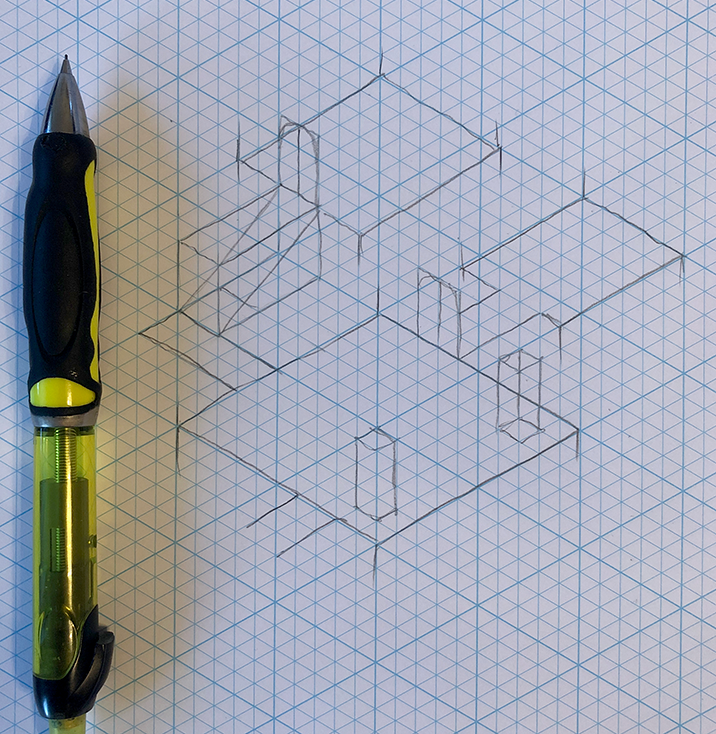
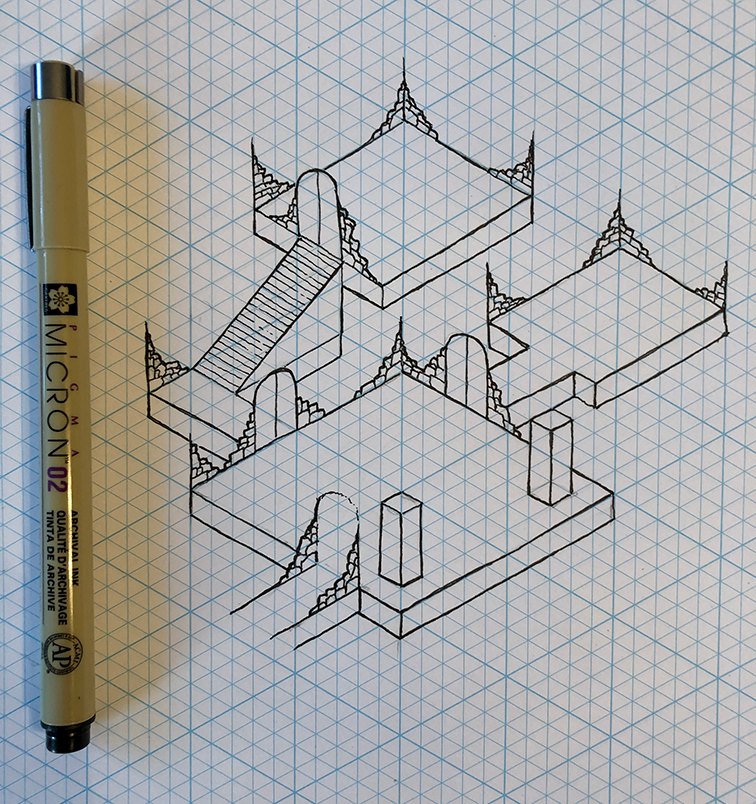
I start by drawing the rough outlines of the map with a mechanical pencil. There's no need for using a ruler, it doesn't have to exist perfect. This is a chip trickier than when you're cartoon a top-downward map, as you lot need to consider the height differences. Objects demand to be considered from three dimensions (for example the pillars and the stairs). Effort to initially think about the objects as cubes, as you tin come across I have done with the stairs, that makes information technology a lot easier
This is the most complex function of the cartoon if you're not used to isometric perspective, then make sure yous're happy with what you got before moving on to the next step.
Step two: ink outlines
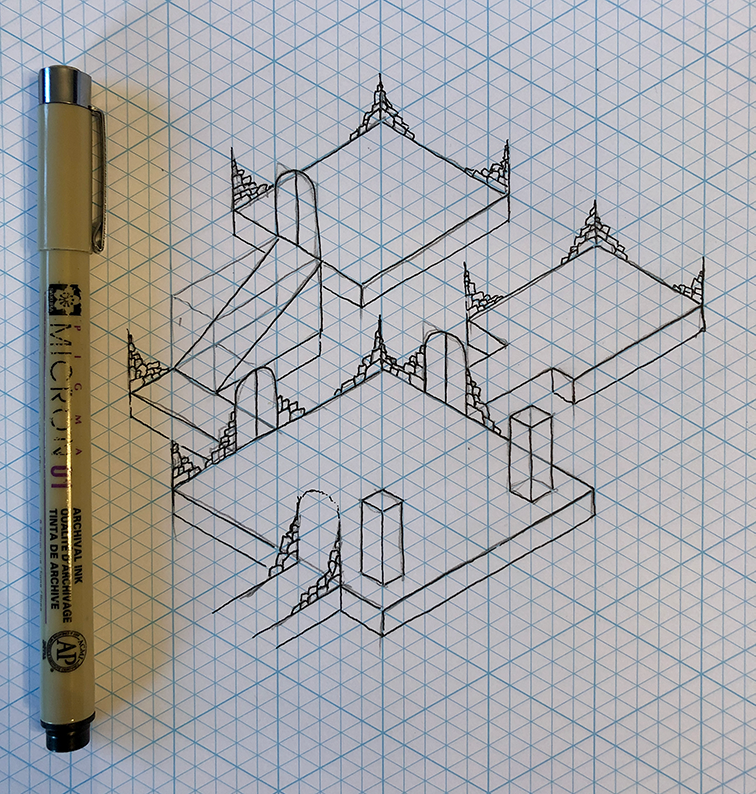
When you lot are happy with your pencil drawing, get ahead and put down the first ink. I use a 0.1 marker for this pace (I will add some weight to them later on).
As you tin see, I also added parts of stone walls to the corners, equally information technology provides a sense of a confined surround, without obscuring the map too much — we don't desire to cover up important stuff!
Step three: add weight
After erasing the pencil outlines, I go over the inked outlines in one case more with a thicker marker, in this case a 0.2. This is done for two reasons: first of all the 0.1 outlines takes a bit of a beating when using the eraser, and second I want to provide a bit of contrast to the texture we'll be adding to the map in the next few steps.
Yous could go for an fifty-fifty heavier outline, simply I settled for 0.2 in this one.
Step four: draw flagstones
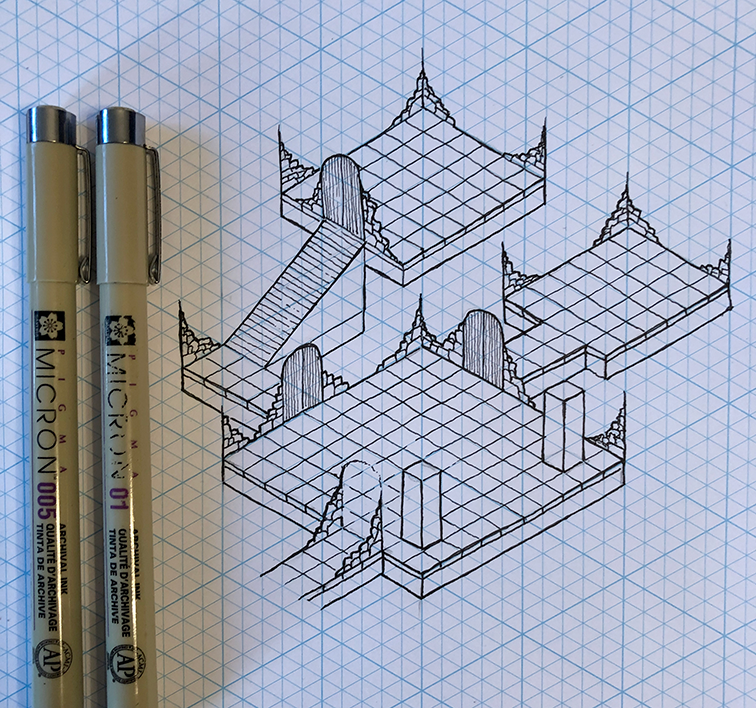
In the side by side footstep I add flagstones with a 0.1 marker. Flagstones are good as they provide a nice surface to add texture to the dungeon, just also helps the dungeon primary should he demand a grid to draw out the rooms on a battle mat.
Annotation that I added some actress definition to the flagstones, making it look like they are a "layer" on top of the ground.
I also added some some woods texture to the doors with a 0.05 mark.
Stride five: texture fourth dimension!
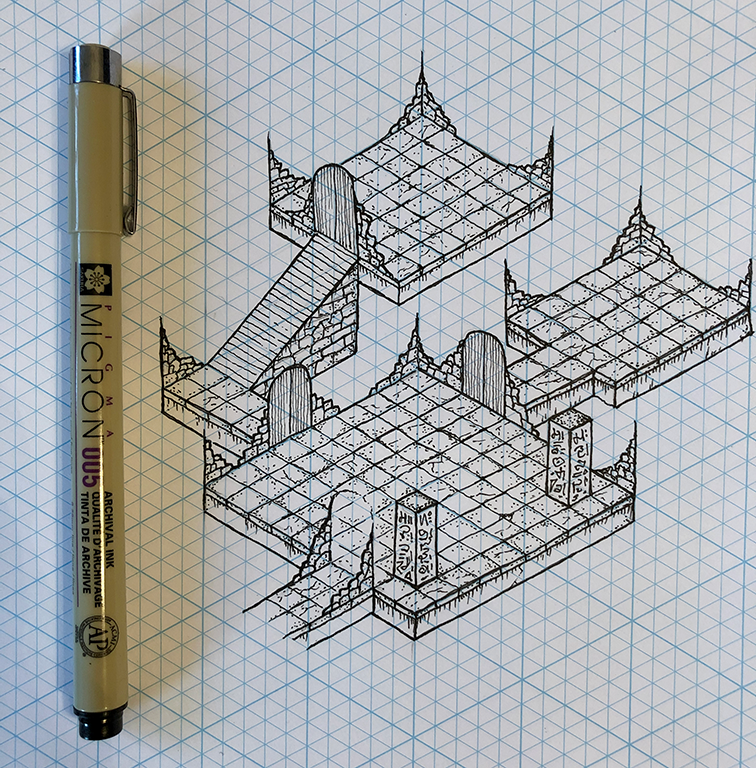
Time to add texture to the dungeon. This is the most time-consuming step, and then if you're drawing a large map, brand sure you have a glass of whisky (or whatever your poison is) and some good background music.
Employ a 0.05 marker to add random dots, scratches and cracks to the flagstones, walls and ground. Likewise, I drew some arcane symbols to the pillars to add together a chip of mystery. Perhaps these are puzzles for the adventurers to solve for the doors to open — who knows?
Step six: add shadows
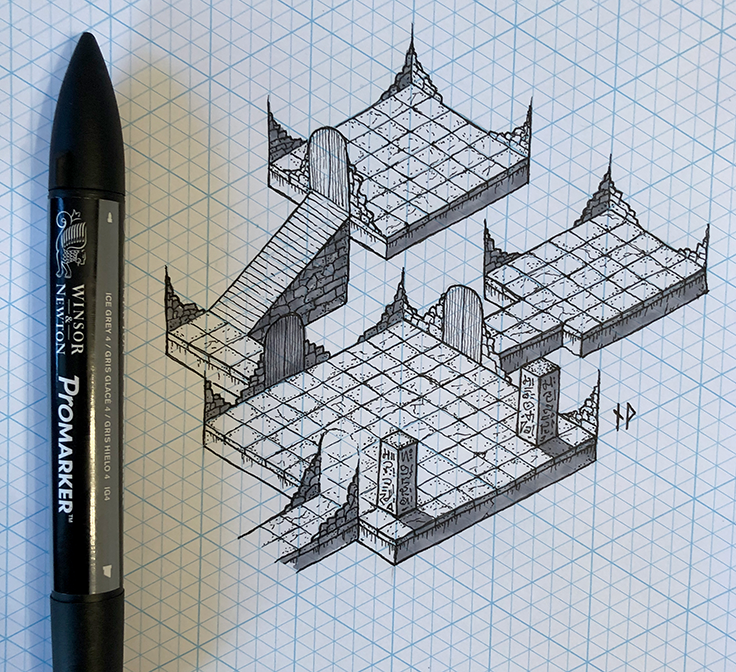
Decide which surfaces should have shadows. In this case, I decided the surfaces facing southward east should exist darker, and drew the shadows with a grey Promarker.
Adding the shadows makes it easier to read and understand the map every bit information technology helps the eye understand how to interpret the perspective. Information technology also adds a bit of contrast, making it await more interesting.
Step seven: make clean up
I use Photoshop to clean up the map. My preferred manner to get rid of the filigree is by taking the steps in this tutorial. I'grand not an proficient on prototype software, so I rely on the knowledge of other people.
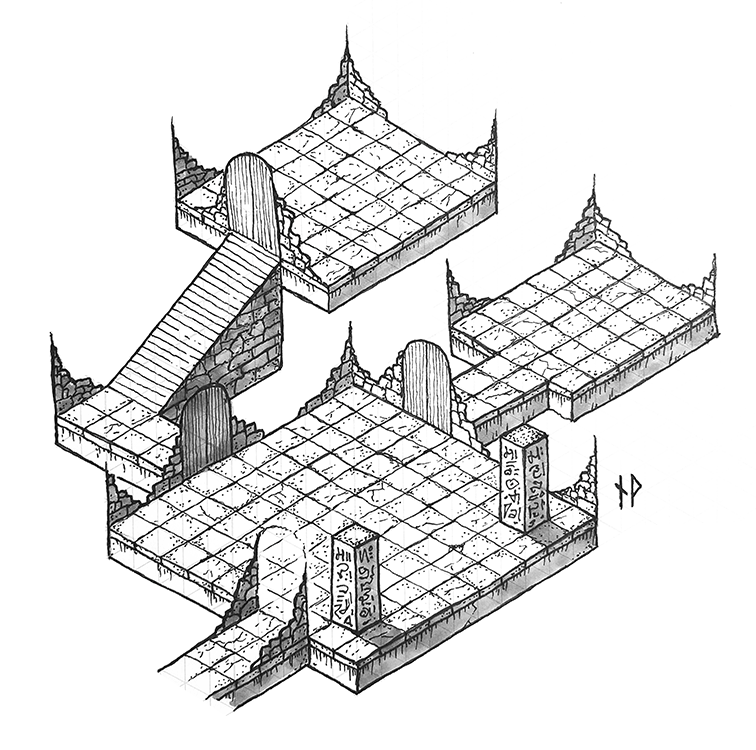
There! The map is done and prepare for play!
More resources:
I mail service a lot of my work on my website, at https://www.wistedt.internet/. There you tin can notice many maps and other RPG recources that are free to download for personal utilize.
If you would like to meet more maps and monsters in your social feed, experience free to follow me on Instagram: https://world wide web.instagram.com/paths.peculiar/
If you would similar to read my first map making tutorial, for top down maps, you can find information technology here: https://medium.com/@niklaswistedt/tutorial-how-to-draw-a-bones-dungeon-map-c9f5c4408327
Bonus: more maps!
Here are some examples of other isometric maps I've drawn, using the above steps:
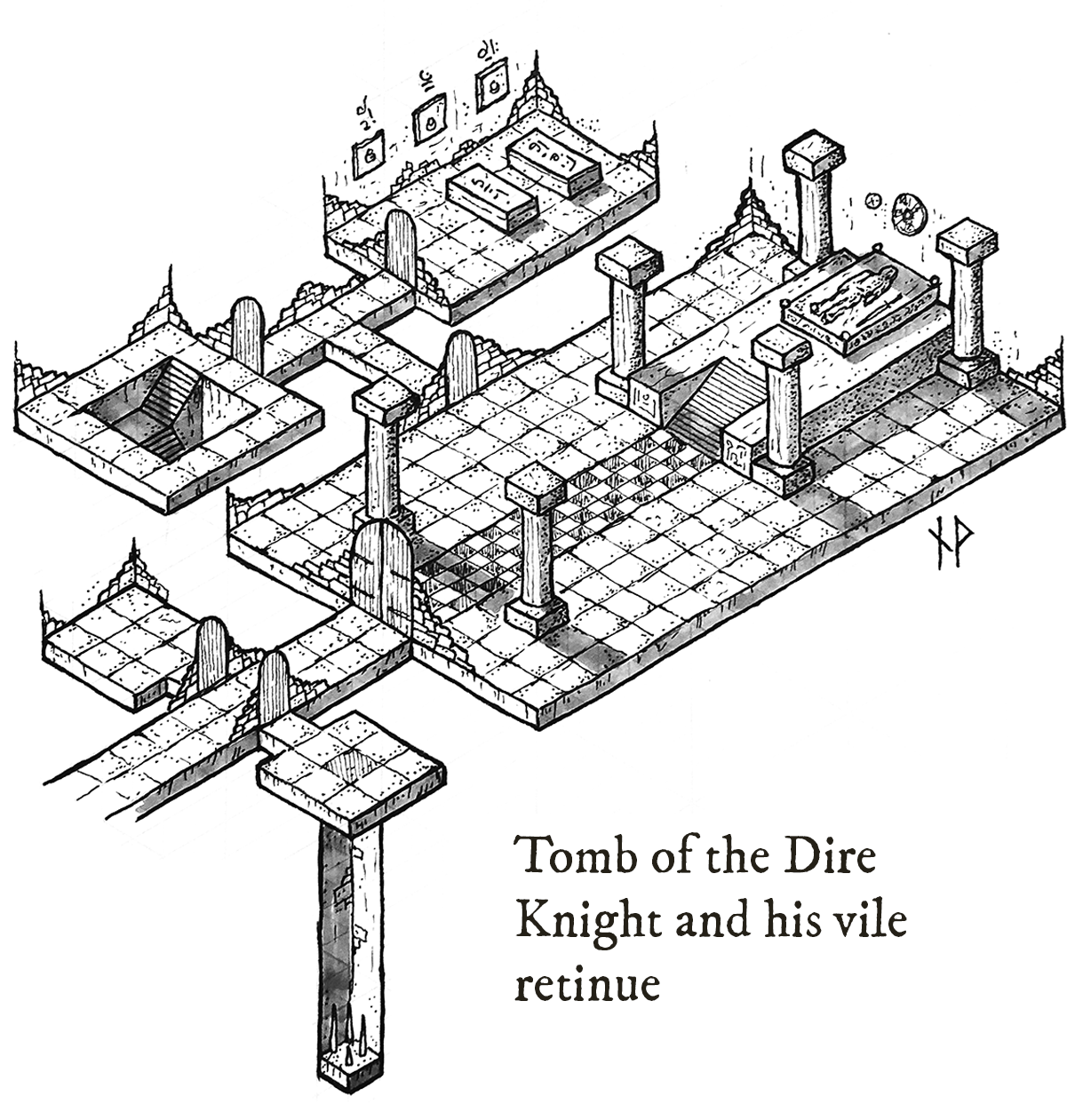
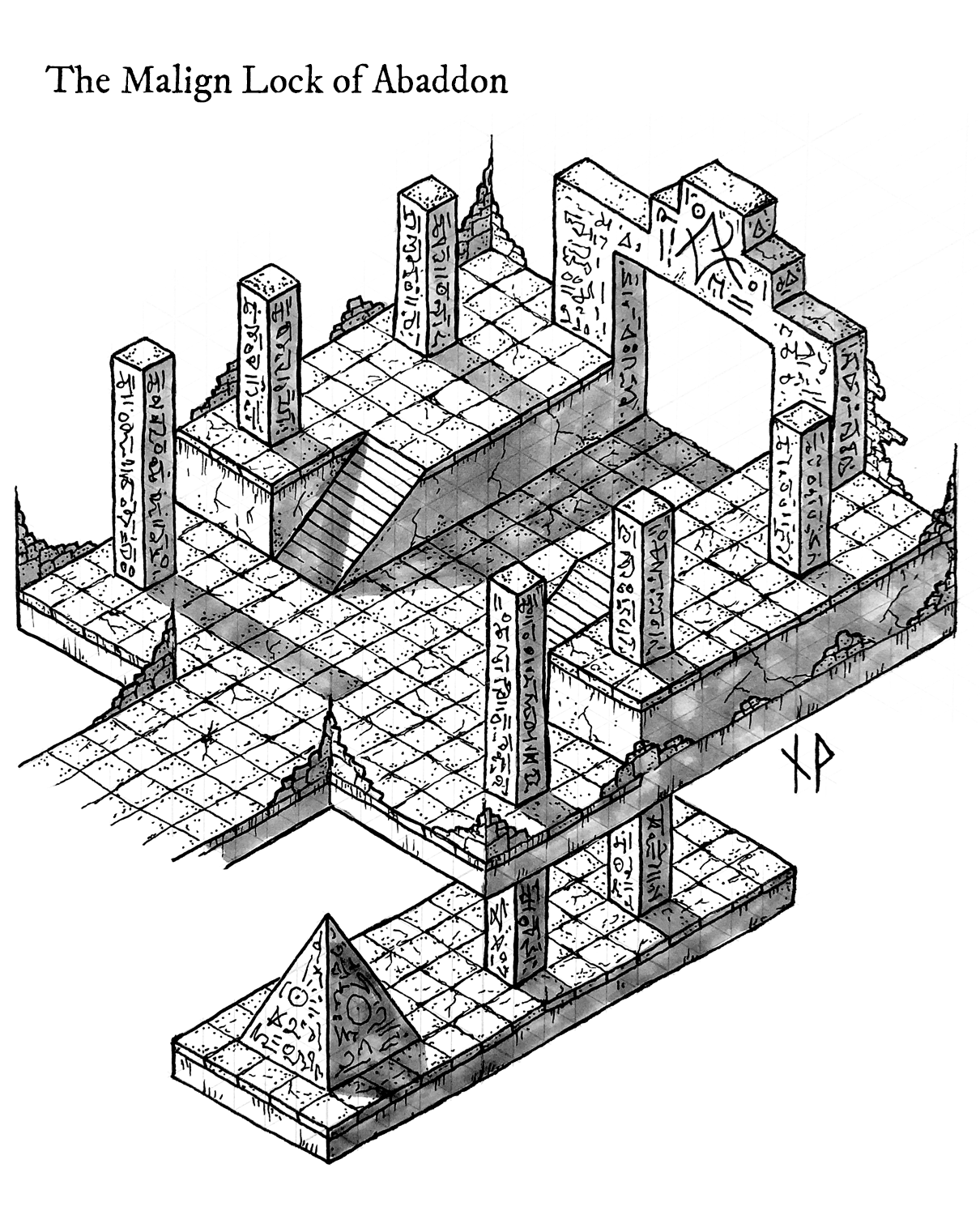
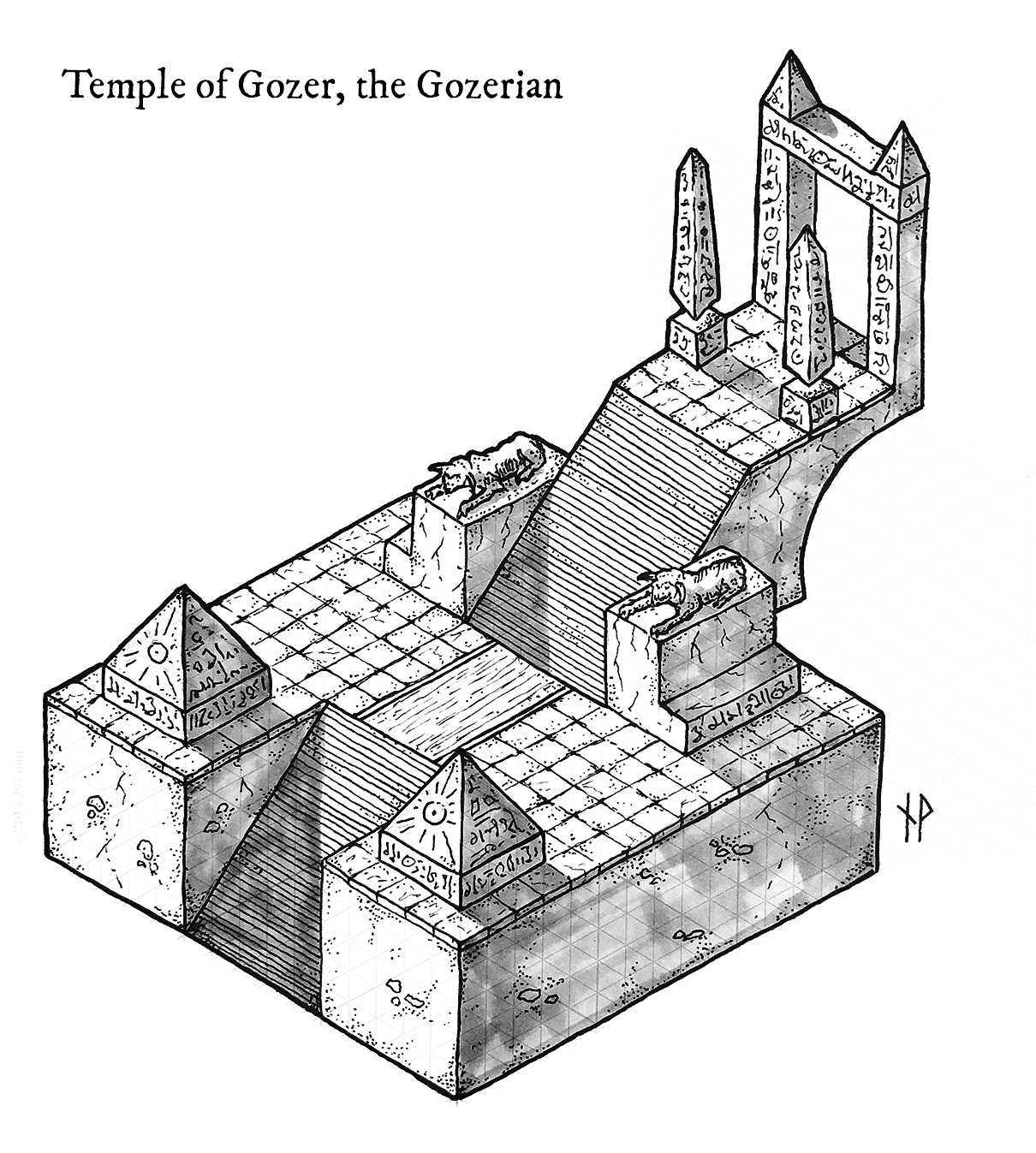

Source: https://medium.com/@niklaswistedt/tutorial-how-to-draw-an-isometric-dungeon-map-dc1a88737be0
Posted by: butlerwheirs.blogspot.com
0 Response to "How To Draw A Dark Room"
Post a Comment